


SURVEILLANCE AND SOUSVEILLANCE
PHOTOGRAPHY PROJECT


.jpg)
Description and key themes:
The aim of my project is to highlight and ridicule how prevalent surveillance is in our society in an informative and humorous way. I wanted my work to satirically comment on the subject of surveillance and present its negative implications on society. Through participating in inverse surveillance in my work and through creating imagery that shows acts of inverse surveillance I wanted to engage in the anarchical 20th century idea of ‘us versus them’ and flip the status quo of surveillance watching civilians on its head by inversing this paradigm. By doing this I wanted to create a comedic irony and also highlight how strange surveillance is through presenting its ridiculousness if its inverse were to occur.
Aesthetically I wanted to draw on the Orwellian 1984 (Orwell, 1949) landscape and paranoia of a heavily surveyed society and through drawing parallels with our cityscapes, technology and political structures expose how we are currently living in a world that is not far off from fictional dystopian futures. Foucault highlights how in a society that is heavily surveyed individuals express a paranoia that they are being constantly watched. We start to imagine how we look to the watcher and in doing so we become our own overseer, this is called panopticism. (Foucault, 1975, p.207)
In my images I wanted to express this panopticism by drawing on the images and iconography that writers, artists and theorists such as Orwell, Foucault and Banksy express in their work. You will also notice intertextuality between my images and the methods of societal control enforced via photography in the past and the present.
Taking and Editing Process:
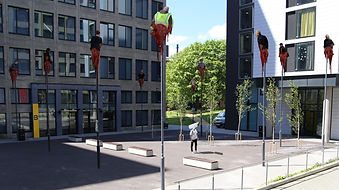
The aim of Panopticon, Tinderveillance and Survfari was to achieve a fantasized surreal look that creates comedy akin to the work of Banksy and Salvador Dali. I did this by using a lot of Photoshop which was an obvious necessity when putting CCTV cameras on people and the guerrillas shoulder[SP5] . In Panopticon I used a wide angle lens to fully capture the width of the courtyard so that I could fit all of the 10 people on poles. In Facial Recognition I used the highest zoom setting on the camera to achieve a telephoto spy-like quality and altered the colour and contrast to create a blueprint look. Survfari and Tinderveillance required me to skewer text so that it fitted with the perspective. In Infinite Self-Surveillance Office I added noise to create a lower quality CCTV camera effect and Photoshopped the images into the monitors.
Commentary and Reflection of Images:
Infinite Self-Surveillance Office
I wanted to highlight the ridiculousness of immense CCTV prevalence by imagining a surveillance office as the target of the surveying eye in a scenario where so much is surveyed by those in authority that they even survey themselves surveying, this shows a concern that we are losing control over the amount that we are being surveyed. The surveillance officers are both figures of authority yet also the victims of surveillance albeit their own. This descends them down to the representation of the typical civilian and transcends the CCTV camera to a higher place of control symbolising how we have become a slave to the machines that we have created and to the implications of their usage. A dystopian imagining in this photo might be of a world where the camera’s start to transcend above the authority of even those that use them in the same way that HAL the camera eyed AI does in 2001 (2001. A Space Oddysey, 1968).
Figure 2. HAL
If we view the security guards as the representation of ourselves then the piece symbolises how through panopticism our sub conscious creates an imaginary sentinel of our psyche that hovers above us and watches ourselves enforcing a paranoia and a form of behavioural control. My image is an embodiment of an ironic inverse surveillance where I am analysing the surveillance equipment and those who are in authority but through the exact equipment and the eyes of those that I am analysing. Note how if you look closely inside the image on the monitor you can see the image of another monitor showing the same image. This results in an infinite paradigm that expresses the widely used artistic motif that camera lenses and the reflections from the screen that we view them from are a reflection into our ego and into the never ending self-analysis of our own psyche.
Panopticon
In this Image my aim was to have two different meanings. The first is that the image aims to recreate a Panopticon, the jail house building designed by Jeremy Bentham in the 18th century that Michael Foucault developed the word Panopticism from. The building enforces a psychological control over the inmates because they believe they are being watched at all times. In my image the people are stuck on the top of spikes in a gory fashion. This shows the way that we are violently trapped within the urban landscape by surveillance and unable to escape its watchful gaze. The amputation of arms symbolises how we are unable to defend ourselves and signal our complaints at the emotionless lenses that watch us. The watchman in the photo is scanning the people who are vulnerable to its searching eye. I decided to feature 10 people because according to a survey there are 10 people to every 1 CCTV camera. The alternate meaning that the viewer could take from the photo is that it enacts inverse surveillance. Instead of a person being watched by CCTV cameras high up on pylons my image features a CCTV robot being watched by people. If this meaning is to be taken I hope that the viewer also questions the implications on CCTV camera’s emotions if they were to develop some form of conscience.
Figure 1. Panopticon
Facial Recognition
In this photo I wanted to imagine a high tech facial recognition interface taking inspiration from the aesthetics of the Bourne trilogy (The Bourne Identity, 2002). The camera’s identify the faces and from a database acquire the people’s names, fingerprint and locations.
Tinderveillance
When using dating apps such as tinder we are bombarded with the faces and specific details of identities. I wanted to draw a parallel between CCTV surveillance databases and the databases for users of dating applications and social networking sites. There is an uncomfortable juxtaposition of sinister imagery and love hearts. ‘MATCH FOUND’ hologram serves as a play on the slogan from tinder and an ironic parallel to the idea of being ‘matched’ that my picture ‘Facial Recognition’ presents.
Survfari
My final image wanted to show surveillance as a King Kong-like monster that holds animalistic reign over our city. A menace that has been unleashed, CCTV technology was once a spectacle and something that people got excited about but now that it has gone beyond being controlled it is scary and imposing. The sign I thought also mocks a sign at a safari, an ironic warning to ‘NOT FEED’ the animal just watch.
Bibliography
Orwell, G.O. 1949. Nineteen eighty-four. London: Secker and Warburg
Foucault, M.F. Discipline and Punish. London: Pantheon Books
2001 a Space Odyssey. 1968. [Film]. Stanley Kubrick. Dir. USA. MGM
The Bourne Identity. 2002. [Film]. Doug Liman. Dir. USA. Universal Pictures
Pictures
Figure 1: Google Images. Panopticon [Online]. [Accessed 18th June 2017] https://www.google.co.uk/search?q=panopticon&source=lnms&tbm=isch&sa=X&ved=0ahUKEwjTqPLh9fnTAhUE2RoKHbnxA7cQ_AUICigB&biw=1920&bih=1014#imgdii=_9a8nFMFk3yCMM:&imgrc=DL_7Gkf1-SJIcM:
Figure 2: Google Images. Hal [Online]. [Accessed 18th June 2017] https://www.google.co.uk/search?q=hal+2001&source=lnms&tbm=isch&sa=X&ved=0ahUKEwiYz-_79vnTAhUFtxoKHXHRCGIQ_AUICigB&biw=1920&bih=1014#imgrc=2y7ai8L42J0awM:


.jpg)


